Wednesday, February 25, 2009

Comet Lulin from Battery Park, NYC

Session name: 20090224.2130


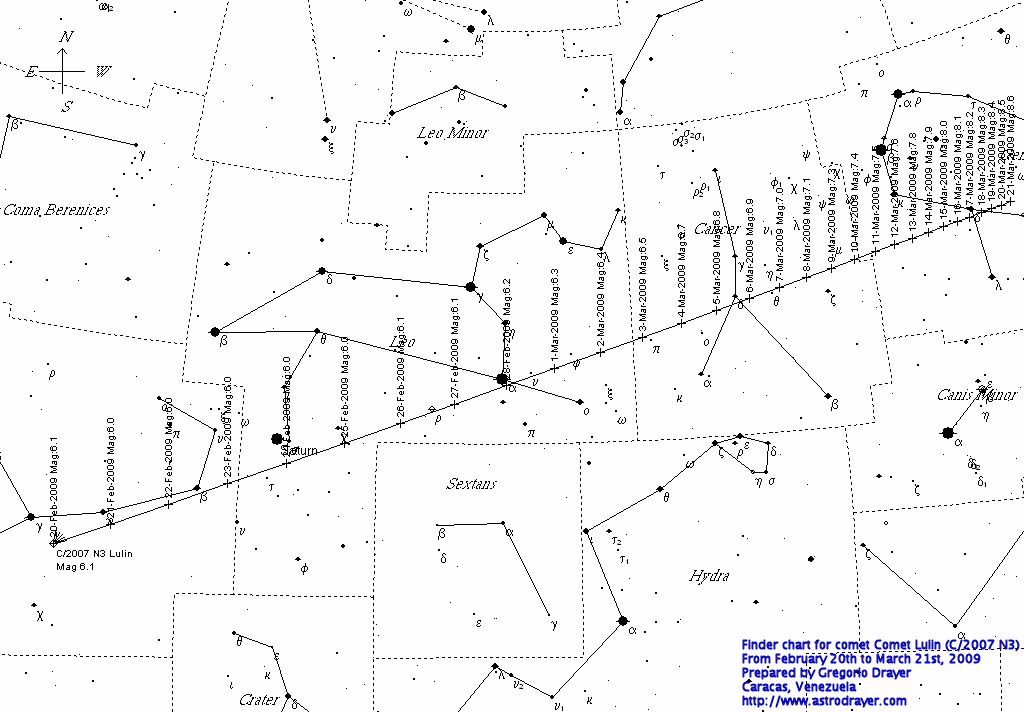
This was my second observation of Comet Lulin using the Tak 22x60 binoculars. An easy starhop from Saturn to xi Leonis (Leo) 5° northwest and finalky landing on 59 Leo** abour a degree and a half west..
A very pale patch light could be seen by the experienced observers about one quarter to a third of a degree northeast of 59 Leo. The comet appeared to be at least 10', maybe as large as 15' in size. I felt something central register on my eye, occurring multiple times I suspected it may have been a steliar nucleus.
Unfortunately many of the others were unable to see Lulin and no wonder. Our observing party was setup directly beneath streetlamps where a blustery cold wind came off the Hudson River. Scope shake and eyepiece glare frustrated many attempts. The low surface brightness was no help. As consolation they were provided a magnificent view of Saturn and 3 moons in John's 6" scope.
After the comet a few diehards, Rich R. and John S., remained to take in some of the brighter open clusters in the immense space above our heads and over New Jersey.

** 59 Leo may ring a bell, it was occulted by the Moon during the 3-4 March 2007 lunar eclipse.

Labels: ,

Sunday, February 22, 2009

C/2007 N3, Comet Lulin observed from Central Park

Session name:20090221.2250


Eyed Comet Lulin for the first time with a pair of tripod-mounted Takahashi 22x60 binoculars from Drip Rock in Central Park. The comet appeared as a very, very faint, featureless blob, however, it had an appreciable dimension. My guess is about 15 ~ 20 minutes of arc, not quite as large as a full Moon, as judged in a 2.1° field of view (FoV). At that size it surface brightness is low resulting in very low contrast with our bright NYC background sky.

The comet was so faint doubt crept in, but repeated observations after moving off and returning to the field of view (FoV) offered the reassurance to call this a positive sighting.

The skies were mostly clear during the half hour observing session. There appeared to be some alto stratus and cirrus clouds, but nothing significant to call disruptive or obstructive. Temps were cool in the 30's (° F) with light to gentle breezes (B2 ~ B3).

The night before I conducted a short session from the same spot and scrutinized this same area. The comet was not observed since it was located nearly 7° further east along the ecliptic. I had the wrong ephemerides for that date, 20090220.2230.

Get a finder chart star for Comet Lulin from spaceweather.com and give it shot. If you're a city observer, let me know how well you fared.

Labels: , ,

Friday, January 04, 2008

Comet 8P/Tuttle Second try with no success

Session name: 20080103.1950

Equipped with tripod and 22x60 binoculars I was unable to detect Comet 8P/Tuttle. The illustration shows a 20° field of view of the area where the comet is located. Ephemeris I used is MPC 60098. (Checking the link, I see it is updated.)

Sky conditions were clear with a light air, temp was sub-freezing. The sky was bright above the Hampshire House and neighboring Essex House, providing a binocular limiting magnitude around 9.1. Naked eye used eta Psc and gamma Ari to zero in on the spot. However, 7x50s and 22x60s yielded no success. Gamma Ari, Mesarthim, a double star with 7.8" separation of the nearly equal magnitudes, was cleanly resolved in the 22x60s.

Labels: , ,

Saturday, November 17, 2007

Comet Holmes from Columbia U. Outreach

Session name: 20071116.2015

I headed up to Columbia University's outreach event to meet up with Kin & Charlie. Jan Kratochvil was giving a public lecture on digital imaging. I recently met Jan at the Urban Starfest. When I arrived Jan was the only one in the classroom as others were on the rooftop inside the domes. This allowed for some one-on-one where he showed & told of panoramic shots and described how to make a gigapixel panorama.

From the rooftop, I could see with the unaided eye Comet Holmes as a very dim smudge near Mirfak in an 8 o'clock direction. Some cirrus clouds coating parts of the sky while more offending stratus clouds approached from the southwest did not distract us from looking. In the binoculars it was more obvious as a large pale ghost of what it was weeks before. The 12.5" telescope offered no justice as the comet's low, low surface brightness does not contrast well with our background sky. Some of the public said they couldn't see it. The comet is noticeably larger but I don't recall if I saw the brighter central condensation. I do know I didn't see the pseudo nucleus. Observing Comet Holmes in low power binoculars continues to provide the most pleasuring and satisfying view, especially with the star field it inhabits.

Local astronomer and comet hunter Tony Hoffman shares a photo of the comet on the same night from Floyd Bennett Field in Brooklyn.

Labels: , , ,

Wednesday, November 07, 2007

Comet Holmes shines above the street lamps

Comet Holmes above the NYC street lampSession name: 20071106.2000

Skies cleared up after the rain where a naked eye limiting magnitude was in the neighborhood of magnitude 5. Comet Holmes continues to be seen naked eye from New York City, even from well lit spots in the city. Find some shade if you can and look toward Mirfak to see an obvious non-stellar object nearby.

Artists' Rock, an outcrop of Manhattan Schist behind Artists' Gate is not the ideal place to observe from (view of area) yet this photo shows a good likeness of the night sky with acute vision unaided. The four brighter stars of Alpha Persei Association show between Mirfak and delta Per.

The comet continues grow in size, my estimate based on ~7 comet diameters to in the 22x60 binoculars' 2.1° field of view is about 18'. The brightness profile consists of an evenly illuminated central condensation surrounded by a paler ring. The coma is about 3 central condensation diameters across. The psuedonucleus was not detected. In acsii it could appear like __/---\__

Its location has moved west, north of west, morphing the right triangle it created with Mirfak and delta Per last week to a flat isosceles.

I find the observation with 7x50 binoculars to be the most pleasing. It takes in the large, richer field of stars that contrast sharply with this dandelion interloper, ready for a breath of air to blow it apart.

Another pleasing view was the Double Cluster observed in the Tak bins. Framed nicely the clusters reveal the stardust that clings around some of the brighter stars; all the while sitting on a bed of uneven faint light.


Marked up photo || unmarked photo


Labels: , , , , ,

Wednesday, October 31, 2007

20071030 - 17P/ Holmes Observing Report


Prior to a brief session, I attended the monthly planetarium show, Celestial Highlights, at New York's Hayden Planetarium. Comet Holmes was given some time both as an object in Perseus and in a series of slides given at the end of the sky tour.

The presenter described Comet Holmes as difficult from the city with unaided eye but revealing in binoculars and scopes. I wanted to disagree but it was his show. He followed up with three images of the comet (one by Pete Lawrence) and for contrast, showed Comet Hale-Bopp with two tails trailing long and high into the sky.

After the show, I went for a brief session to TotL to take in the comet naked eye and with the 22x60 binoculars. I carried the Tele Vue Ranger to get tighter shots of the comet but it wasn't unpacked.

On my way around the Great Lawn I ran into Mark the Literary Agent. He stayed and we observed the comet and the passing people watching the two guys watching a comet. I didn't invite people to the bins nor did anyone ask but a few. One was Ken the Pilot who stopped to say, "Hello." He peeked in the bins and said, "Oh that's the comet. Not that impressive." I described the same features to look or that I described to Mark earlier.

My observation is that comet 17P/Holmes appears to be dimming. I compare to delta Per which is celestial-South, or around 9:00PM EDT, directly to the right naked eye. Their brightness looks nearly equal. The pedestrians that stopped to observe it naked eye agreed. They added the description that it looked fuzzy compared to the other stars (naked eye). Same observation to me. Late last week, the comet's brightness was almost midway between the brightness of delta Per and Mirfak, alpha Per. The comet's size is obviously growing.

Location in field of view
There are two ways that I help the pedestrians look for the comet, one from the direction of Cassiopeia and the other from Capella in Auriga. Around 9:00PM EDT, Capella has risen almost 25­° above the horizon due manhattan-north. The brightest star in the area is unmistakable and difficult to miss. With an extended, open right hand put your thumb on Capella and rotate your pinky up to about a one o'oclock direction. You'll notice another bright star, Mirfak. Consider Mirfak the apex of a tall, isosceles triangle. Two fainter stars are seen below Mirfak. Relax, give it a moment or two for your eyes to adjust to see the triangle. The base star to your left, may appear fuzzy, since this is the comet. Easily seen from the city as many pedestrians made it out with a little coaching.

In the binocular 2 degree field of view, the comet appears near the inside right corner of a right triangle. These three stars: mag 6.18-HIP17772; mag 7.72-HIP17713; and, mag7.55-HIP17476. In my mental image 17772 & 17713 are the base of the right triangle.

Size
The separation between the two base stars is 23'15". I estimate that separation to be 2 1/4 ~ 2 1/2 comets yielding a size of 9.3' ~ 10.3' for the head of comet.

Brightness
I didn't perform an in-out test for brightness. That is choosing stars of similar magnitude and bring them out of focus so that the star's size increases to s large as the diameter of the comet. If the comet's brightness appears equal to the star's de-focused brightness then the comet's brightness is assigned a value of the star used for testing.

The outer coma exhibits an uneven brightness, a darkening can be seen on the leading edge side. It is arcuate and extends almost halfway around the central condensation (what I have been calling the nucleus.)

As the comet grows larger its surface brightness decreases. The brightness is distributed across a greater surface area of the comet. (Consider the brightness and the appearance of M33.) This results in less contrast with the background sky and appears dimmer to the eye.
With unaided eye, compared to delta Per, 17P/Holmes' brightness is approaching delta's brightness, Late last week it was almost midway between alpha Per (Mirfak) and delta Per. Over the past few days I feel it is dimming, due to the explanation above.

Shape
The comet appears round with three sections of varying brightness. The coma appears with a bright central core which is about two-fifths of the comet's diameter and off-center relative to the outer coma ring. It is south of the leading (drift) direction. Within that brighter central condensation on its trailing side, a stellar condensation is evident. Its obvious in most photographs of the comet. I did not see any evidence of a tail.

This message posted with nBlog.

Labels: , , , ,

Tuesday, October 30, 2007

20071029 - Brief Observation of 17/Holmes

20071029 - Brief Observation of 17/Holmes

A very short session looking through the living room window with Fujinon 7 x50 binoculars hanging from my neck and hands cupped to my eyes. Unaided I see the familiar tall right triangle with comet 17/P Holmes at its lower left base star. delta Per is the right angle to the west and Mirfak, at tip of the hypotenuse, is the northwestern acute angle.

The comet appears dimmer than delta Per. Like most we have watched it brightness increase Over the past few days but now it looks as if it is past peak and its brilliance diminishes gradually. The fainter appearance can be attributed to its growing size which could result in a lower surface brightness if its absolute magnitude doesn't change (if could say this for a non-stellar object such that it doesn't produce its own light)

In the 7x50 the comet head is large enough to easily discern a nucleus within the Coma. I don't see the off-centering of nucleus to the leading edge like I saw the night before. Nor can I see that tiny stellar point (or two) on the leading edge of the nucleus. On past observations, I felt that the nucleus had a fan-shape to its brightness with the stellar point just interior to a snub-nose point. Could be optical illusion but I can see the same detail in pictures. In the hand held bins I could not see this detail.

Still a remarkable sight to see. And as you're looking at it realize that it is Cosmic sibling of the Solar System.

posting with nblog

Labels: , ,

Sunday, October 28, 2007

With the gang - 17P/Holmes

Session name: 20071027.1935

Larger images: Marked up | Unmarked
Compare with this Perseus image from this post, where Comet Holmes is obviously unseen in the general area.


The comet continued to capture out attention and interest. Under other circumstances a disappointing lunar occultation of the Pleiades past midway on our moonrise would have been center stage. But not. Not with the comet of 2007 juicing up Perseus. Tycho had SN1572 in Cassiopeia and we have comet Holmes. Different as they are in nature is as great as the excitement of this new temporal light in the sky.

I arrived at TotL to see Ben already set up with his Tele Vue 76 aimed at Comet Holmes. He invited me to the scope asking if I saw any peculiar features. After getting eyepiece-adapted, a bright stellar point was visible on the interior, southwest edge of the nucleus. This larger nucleus continued to appear off center towards the east-southeast direction (towards the trailing side in the refractor's field of view) within the coma. The coma's circumference had a bright, consistent brightness, however, its interior was uneven with some dark patches. This was most pronounced on the leading edge, like a backward "C". This was the greater side of the coma as mentioned earlier that the nucleus was slightly displaced to the trailing side. AAA'er Bruce Kamiat (report) pointed out this feature which Ben & I agreed to seeing.

Ben & I disagreed on sizes. At first, I grossly over-estimated the size with a wrong mental image of Jupiter. I suggested the size of the nucleus to be something four jovian diameters, the overall sie of the head to about 6 jovian disks. Ben's estimate was more reserved as one jovian disk. Mars had cleared the trees so we used the ~12 arc second martian diameter to measure the components of the comet's head. I estimated the nucleus to be 3~4 martian diameters across, if I remember Ben's was less. On the leading edge, the coma was about 2 nucleus diameters and on the trailing edge about 1 1/2 nucleus diameters.

Down to our south, an area we call Turtle Pond Observatory (TPO) another crowd of astronomers had naked eye and optics turned to the sky to show the passing public. Turns out it was Kentaurian with some of the AAA'ers: Rich Rosenberg, Bruce Kamiat, and Joe; Rik Davis joined shortly after. They came up to TotL to join in on the cheer. Hawaiian George came by and so did Team Totl'er Kin riding in with a small group of TIME'S UP! riders led by Rich. Debbie, a dog owner, who used to observe with us appeared tonight. We had a thin regular flow of pedestrians passing through as we were eager to share sights with pointed fingers and optics.

Seeing was not the best and a light breeze caused scope shake when the magnification was increased to 117x on the Takahashi refractor. When the air calmed for a steady view the Moon was absolutely stunning along the terminator. Cruising along the line sunset it was difficult to ignore craters Langranus and Petavius. Rimae Petavius runs across the crater's floor. To the northeast, sunset begins where the far eastern walls of Mare Crisium try to repel blackness. Not for long.

A small diversion while near the comet was to spot NGC1528. A bright open cluster that I prefer with a darker sky without a nearby ~17d moon. Tonight only the brighter members stood out in a loose, sparse arrangement of crisscrossing arcs of stars. The same comments apply for M31 and M32 but for one pedestrian we gave here a small survey of the different heavenly objects.

During our observing session we placed a towel on one of the street lamps to block of the glare in our direction. The other lamp to our east spilled its light casting long thin shadows to the west. From high in the east, Moonlight competed casting darker, harder, shorter shadows. Crisp as bacon.

Lastly we visited Mars before packing up. It was still rising and seeing was not greatat even at an altitude of ~34°. I thought I may have seen some detail at magnification 117x but it didn't agree with Brian Tung's Mars Map. I thought I saw a dark band running central across the diameter of the disk, rather a large chord instead of an equatorial band. The trailing limb had a greater darkening on it.

Kin, Ben and I packed up for the evening a bit past 1AM. We pulled the towel from the street lamp to bring back the illumination and shadows leaning east.


Labels: , , , , , , , ,

Friday, October 26, 2007

17P/Holmes - Naked eye comet

Session name: 20071025.2105

A photograph of comet 17P/Holmes where a bright central nucleus outshines the surrounding ionized gases, the coma. The nucleus and the coma form the head of a comet. This comet lacks any tail.

Observed the bright 17P/Holmes, my guesstimate is magnitude 2.3 ~ 2.5. It is less bright than Mirfak, brighter than delta Per, cheating towards Mirfak. Comparing to the few other brighter stars that beat the clouds, only Mirfak and Capella were brighter. So bright it shone through the cirrus and cirrostratus clouds. With naked eye, the comet's size is visibly greater than nearby stars though no tail observed. In 7x50 binoculars it is obvious in brightness and dimension. In 22x60 binoculars, the nucleus resolves clearly off center from a round coma.

Effect pronounced because of the clouds?

Discovered in 1892, Comet Holmes takes 7.3 years to revolve about the Sun. No one can say for certain how long this brightness will last - a few days, weeks, or months. Either way get out soon and take it in as early as possible.

What makes it glow so brightly? Most likely cause is the result of an eruption, heated gases from within escaping violently through the comet's crust. Think in terms of volcano, common activity with Solar System objects. A comet's crust and surface consist of loose accumulation of ice and rock so it becomes susceptible as it approaches the Sun and heats. When the gases expire or cool down the volcanic-like activity ceases and the comet goes on its merry way.

The session was not without frustration. I chose to observe from Artists' Gate, the south Central park entrance used to refer to as The Statues. I really couldn't find a spot without interference from the street lamps and I didn't want to venture too far into the park in this area alone. Many places are off the beaten path. I ended up on the rock smaller in stature than Drip Rock. I left the SD card of one camera in the computer at home and the other camera simply misbehaved with the dreaded remote control. In the end I was able to capture a few photos and scratch a sketch or two.

A young guy, Jesus, who drives the Hansom Cab driver, stopped by. He reminded me that we've met before and that he hadn't picked up a scope yet. He asked some questions about the wonders of the sky. With naked eye and mounted Tak bins, we observed 17P/Holmes, rising Mars, and the Moon. We spoke of how rising stars appear to twinkle with rainbow effect as we look through more atmosphere due to our our angle. Castor was a shining example.


View of the sky from a tucked away spot on the rock inside of Artists' Gate. The sky improved and was clear for a period of time but the cameras were not cooperative. Naked eye limiting magnitude from this area under these conditions was around magnitude 3.5


Skychart of area around alpha Perseus and the Fishhook.


Marked up version of skychart of area around alpha Perseus and the Fishhook.


Labels: , ,

Friday, January 19, 2007

not my time with McNaught

I missed the whole McNaught thing, observing wholly on the Internet.

This past Tuesday (1/17), Ben a fellow TotL'er issued an unexpected invite to observe daytime McNaught. I was sort of caught off guard not knowing where the comet was or if it was daytime object. Work has occupied a better part of my days that I didn't think I could steal away at lunch. As luck would have it, time freed up and I met Ben at Bryant Park. He had his TV-76 and I with my Takahashi bins.

In short, Bryant Park was not an agreeable place since the horizon consists of rooftop cornices rising easily to 30° in the lower parts. Tree branches confused the field of view with the unfocused shadows tangled with the bluish, white sky. Ben & I tried from various spots with the park but we agreed that if it was visible it was below the rooftops.

Kin would report later in the day that he was unable to see it in binoculars from Union Square Park. I assume his horizon was better.

When we abandoned that hunt, our attention turned to Venus. In the scope, binoculars, and fleetingly naked eye we stood and observed Venus while talking of old & current times. I didn't turn my attention to Mercury and I pretty much ignored the Sun, using our star as a landmark to measure off to Venus - almost a full handspan, pinky to thumbtip (then curl thumbtip in to subtract 2°) separation.

I have missed events in the past primarily due to weather. This year it was due to schedule and priorities - hmmmm.

Labels: , ,